Showing posts with label Presbyterians for Just Immigration. Show all posts

Tuesday, July 28, 2015

Faith Leaders Celebrate Court Decision on Family Detention; Call for Administration to Comply

Children at the Dilley, TX facility
Source: Charles Reed,
U.S. Immigration and Customs Enforcement
The Presbyterian Church (U.S.A.) Office of Public Witness and the Presbyterian Office of Immigration Issues have been deeply engaged in the struggle to end the unjust incarceration of asylum-seeking migrant mothers and children in three family detention facilities. On Friday, July 24, a U.S. District Judge ruled that this detention is illegal. Read more below, including a statement by Rev. Gradye Parsons, Stated Clerk of the General Assembly of PC(USA).


-------------------------------------------------------------------------

***PRESS RELEASE***


FOR IMMEDIATE RELEASE                                                   
July 27, 2015      

Contact: Shaina Aber                                                             202-629-5918 
saber@jesuits.org                                                                                  


Faith Leaders Celebrate Court Decision on Family Detention;
Call for Administration to Comply

WASHINGTON – Late on Friday, July 24, 2015, U.S. District Judge Dolly Gee ruled that the Obama Administration’s practice of detaining immigrant families violates the 1997 settlement in Flores v. Meese and all families, excluding those who pose a flight or national security risk, must be released as soon as possible.

The Flores settlement set guidelines for the detention of unaccompanied migrant children: if they are detained, they should be held in the least restrictive environment possible, cared for by licensed professionals. Judge Gee ruled that the settlement also applies to children detained with their mothers. She has given the federal government until August 3, 2015 to respond, or she will implement measures to enforce her ruling. Over the past two months the federal government and the plaintiffs have failed repeatedly to reach an agreement.

In response to the influx of almost 70,000 Central American families seeking asylum last year, the federal government began to detain mothers and children en masse in three dedicated facilities – Karnes City, Texas; Dilley, Texas; and Berks County, Pennsylvania. Since June 2014, 6,300 mothers and children have been booked into a family detention center. Currently, 1,700 mothers and children are being detained, even after Department of Homeland Security began their release of some mothers and children who have demonstrated a credible fear of returning to their country. According to the Women’s Refugee Commission, 88% of recently detained mothers have passed screenings for credible fear of return to their countries of origin.

The challenge to family detention came from counsel on behalf of several detained mothers. DHS responded with disappointment in the ruling, maintaining the government’s need for detention as a means of responding to mass influxes of immigrants at the border, such as the surge last summer.

Advocates, including dozens of faith groups, rejoice in Judge Gee’s ruling and plea for the Obama administration and DHS to comply. They will continue to push for the decisive end to this inhumane and immoral practice.

Read faith leader statements below.

“I applaud the July 24, 2015, ruling by Federal Judge Dolly Gee, joining the chorus denouncing family detention, reaffirming that migrant children must be released to foster care or relatives and placed in the least restrictive environment possible.  Her ruling echoes the prophet Isaiah’s call to seek to “correct oppression” (Is. 1:17) and enables our nation to better “speak out in defense of the poor” (Prov. 31:8-9).

Family detention exacerbates the trauma families have already experienced, profits prison companies, isolates legitimate asylum seekers from services, and constrains hope that liberty might ever be found.  Judge Gee’s order instructs the administration to develop a plan to release the mothers and children “without unnecessary delay.” I strongly urge the administration not to appeal Judge Gee’s decision. It is not illegal to seek asylum, and mothers and children should not be treated like prisoners. Around the U.S., our members have stood with faith partners in ditches outside centers to pray, have signed letters, visited legislators and White House staff, provided education, and made calls to build momentum for mercy and to say resoundingly that family detention is immoral. Our prayer is that it will end.” 
The Rev. Dr. Sharon E. Watkins, General Minister and President, Christian Church (Disciples of Christ) in the U.S. and Canada

“Church World Service applauds Judge Gee’s ruling. The criminalization and detention of families seeking asylum and refuge is a moral stain on our nation. Our country has a moral and legal obligation to respect asylum and protection laws. CWS will continue to advocate for the immediate release of families held in detention centers and the reduction in the overall use of detention”
The Rev. John L. McCullough, President and CEO of Church World Service

“We are heartened by the judge’s decision to end the policy of detaining immigrant women and children. A policy that blames women and children for fleeing violence, puts them in detention, and then expedites their deportation directly contradicts our values as people of faith and a nation of immigrants.”
Scott Wright, Director of the Columban Center for Advocacy and Outreach

"We commend U.S. District Judge Dolly Gee for her wisdom and justice in the Flores ruling that is consistent with Catholic Social Justice Teaching and highlights this country’s commitment to life, our concern for the most vulnerable, and our steadfast allegiance to dignity for all. This decision enlivens the truth of Pope Francis’ statement, “No cell is so isolated as to exclude the Lord, none. He is there, ... His paternal and maternal love reaches everywhere.” (Pope Francis, Vatican City, Audience for National Congress of Italian Prison Chaplains, 10/23/2013.)  We commit our prayers and resources to oppose future appeals to this decision."
Sr. Louise Gallahue, DC, Vistatrix of the Daughters of Charity of the Province of St. Louise


“Our faith compels us to seek a complete end to the failed policy of family detention. We urge the administration not to appeal Judge Gee’s ruling that detaining children violates U.S. law. The administration should cease allowing private prisons to profit off of jailing children. We must instead whole-heartedly turn towards community-based alternatives that both keep families together and answer to that of God in the women and children seeking refuge.”
Diane Randall, Executive Secretary for the Friends Committee on National Legislation

“Our Jewish values and history call us to protect life and to love the stranger. As American Jews, we must work to ensure that anyone who reaches our border is afforded safety and dealt with fairly. This ruling confirms that the U.S. government is not living up to its obligation of ensuring the proper care of children in its custody. The Jewish community has long supported policies that promote human rights and ensure the protection of children. We must continue to press our government to live up to these ideals.”
Rabbi Jennie Rosenn, Vice President for Community Engagement at HIAS, the global Jewish nonprofit that protects refugees.

“The Leadership Conference of Women Religious (LCWR) welcomes the recent ruling by U.S. District Judge Dolly Gee which we trust will put an end to the detention of immigrant children and their mothers. We urge President Obama and Secretary of Homeland Security Jeh Johnson to implement the court’s finding as rapidly as possible. We continue to be concerned about the failure of our present immigration system to treat all with the dignity and respect that is their God-given right.”
Executive Director, Sister Joan Marie Steadman, CSC

“We welcome the Judge’s ruling that no child belongs in a secure and unlicensed detention facility and strongly agree that parents should be released together with their children whenever possible. No child or family belongs in jail. Lutherans, and people of faith in communities all across America, stand ready to welcome and embrace our new neighbors as they are released from family detention facilities.”
Linda Hartke, CEO and President, Lutheran Immigration and Refugee Service

“The National Advocacy Center of the Sisters of the Good Shepherd applauds Judge Gee's ruling that condemns the incarceration of women and children.  We hope the Obama administration will abide by her wise and compassionate decision and not appeal.  These incarcerated women and children have suffered enough.”
Lawrence Couch, Director of the National Advocacy Center of the Sisters of the Good Shepherd

“We at NETWORK welcome the US District Court ruling that hopefully begins the end of family detention of undocumented immigrants. The Court recognizes the reality that we have been advocating as common sense: children and their mothers do not belong in prison-like settings. We are extremely grateful to Judge Dolly Gee for helping to ensure that children and their mothers will now await their asylum hearings in safe surroundings and not in custody. We urge the Administration to put families first by not appealing this decision. “
Sister Simone Campbell, SSS, Director of NETWORK, A National Catholic Social Justice Lobby

“So many in the faith community have been praying for something, such as Judge Gee's ruling, to advance the movement to end family detention. Today, we rejoice and continue to pray that the government will not appeal this decision and that, soon, thousands of asylum-seeking mothers and children will be freed.”
The Reverend Gradye Parsons, Stated Clerk, Presbyterian Church (U.S.A.)

"The Sisters of Mercy celebrate Judge Dolly Gee's ruling on family detention. We ask the Obama administration to take immediate actions to end the shameful policy of incarcerating refugee women and children. President Obama's decision to appeal the ruling or comply with Judge Gee's findings will determine his legacy on immigration, as much as his fight for comprehensive immigration reform and deferred action."
Sr. Patricia McDermott, President of the Sisters of Mercy of the Americas

"The court decision is a striking affirmation in defense of vulnerable Central American children and mothers and on behalf of the rights of asylum-seekers widely. We urge the Obama administration not to appeal the court's ruling, but to embrace it, to abide by it — and to immediately release all mothers and children now being held, so they can await their asylum hearings in compliance, yet in the safety and freedom they've been denied. 
It is time to close the door on this painful and shameful policy. Not jailing children and mothers is a legacy that befits the President."
The Rev. William Schulz, President and Chief Executive Officer, Unitarian Universalist Service Committee

“United Methodist Women members have been actively engaged in efforts to end family detention: marching outside the detention center in Dilley, Texas; using social media; sending postcards to President Obama; and sharing and mobilizing at Mission u events across the country. United Methodist Women celebrates this legal victory and urges the administration not to appeal this ruling. Mothers and children should be released from detention immediately. Furthermore, release from detention should not entail separating mothers and children; demanding exorbitant bonds; forcing mothers to wear GPS monitoring devices; or expediting the deportation of mothers and children. We seek a policy that guarantees due process for all including appeals on deportation orders, and which ends all family detention without an undue burden on families that have suffered more than enough.”
Harriett Jane Olson, General Secretary and CEO, United Methodist Women 

###


Tuesday, July 21, 2015

Action Alert: Congress, Protect the Human Rights of Migrants!

It’s almost the end of July and the season of Congressional appropriations is in full swing! By September 30, Congress must pass 12 different appropriations bills to fund the U.S. government for fiscal year 2016.[1] One of these appropriations packages, the State Department and Foreign Operations bill, includes various forms of aid to other countries.

The House version of the bill (H.R. 2772) conditions humanitarian aid funding for Central American countries on their commitment to improving border security and interdicting migrants, particularly unaccompanied minors, trying to reach México and eventually the United States. [2]

The Northern Triangle of Central America-- Guatemala, El Salvador, and Honduras-- have erupted into levels of incomprehensible violence due to the rising control of gangs and lack of economic opportunity. The mass exodus of Central American children and families has been the result.[3] These conditional provisions in the bill seek to strategically keep Central Americans from ever reaching our southern border. The United States has already begun this process to externalize our southern border. Since last year, the U.S. has funded, armed, and trained Mexican, Honduran, and Guatemalan law enforcement to stop migration from Central America, without regard to the well-being or human rights of migrants.[4] The provisions in the House bill would amplify these efforts to keep Central Americans from exercising their internationally guaranteed right to flee trafficking, persecution, and violence as asylum seekers [5] to the United States and other countries.

We must not continue down this path. Instead, we should be investing in protection and post-repatriation services for migrants, along with addressing the root causes of migration—violence and poverty.

The Senate version of the bill (S. 1725) does not include these damaging conditions. It does, however, include positive provisions to condition assistance to Northern Triangle countries on their efforts to combat corruption and ensure transparency, protect human rights, implement policies and reforms to address root causes of poverty and violence, and reform the police and the role of military forces in policing, among many.[6]

When the House and Senate go to conference to reconcile their two bills, we want provisions like those in the Senate bill to remain and border security provisions like those in the House to be eliminated.

What does the PC(USA) say about asylum-seekers and refugees?

The General Assembly of the Presbyterian Church (U.S.A.) has affirmed many times (1990, 1994, 1999, and 2014) [7] the need for U.S. immigration policy to protect the rights of refugees and asylum-seekers, in accordance with the Gospel mandate to care for the most vulnerable.

In 1990, the 202nd General Assembly of the Presbyterian Church (U.S.A.) resolved that any immigration-related policy must “uphold international standards and accords regarding protection to refugees and persons in refugee-like situations…” and “address the U.S. economic, political, and military policies that may contribute to conditions compelling human displacement and migration.”[8]


Primarily Central American migrants board a Mexican freight train known as
 'La Bestia," "The Beast" to reach the U.S. border.
Source: www.macleans.ca 


[1] The past few years, Congress has not passed all twelve bills before the deadline, so all twelve bills have been wrapped into one “omnibus bill.” Read more here: https://www.nationalpriorities.org/budget-basics/federal-budget-101/federal-budget-process/
[7] 35.143. Pp 520; 30.141. Pp. 243; “Transformation of Churches and Society through Encounter with New Neighbors.” PC(USA) Statement. Pp. 353-355; Commissioner Resolution. On the Global Crisis for LGBT People and Their Families: A Presbyterian Church (U.S.A.) Response. 09-20. http://pc-biz.org/PC-Biz.WebApp_deploy/(S(ips21ra3w0zttk2dvlduyrgf))/Explorer.aspx?id=5073
[8] 35.143. Pp. 520.

Friday, May 8, 2015

Action Alert: Tell Congress to #EndtheQuota

Since the start of fiscal year 2010, Congress has allocated Immigrations and Customs Enforcement (ICE) the funds to incarcerate over 33,000 immigrants in deportation proceedings each day (increased to 34,000 in 2013). This is known as the immigrant detention bed quota. In fiscal year 2014, 32,163 immigrants were detained every day at the cost of $2 billion dollars.[1] More than a blatant misuse of tax dollars, the quota wreaks havoc on immigrant communities, ramping up the deportation and separation of families.

Senator Robert Byrd (WV) inserted the quota into the 2010 appropriations bill under guise of providing enough detention beds for immigrants going through deportation proceedings. It is the only legally mandated quota system within all federal and state agencies. From the start, it has served as profit motive for private prison companies like Corrections Corporation of America (CCA) and GEO Group. Between 2008-2014 CCA spent $9.8 million dollars lobbying the DHS Appropriations Subcommittee, the home of the bed quota. Since 2009, the industry’s share of immigrant detention beds has increased by 13 percent; now, these companies operate sixty-two percent of immigration detention beds.[2]

While detaining immigrants to ensure they show up for court should be a last resort, the bed quota encourages it. In 2013, ICE detained nearly 441,000 immigrants.[3] Many of those incarcerated include asylum seekers, Central American families, and survivors of torture and trafficking. Effective alternatives to detention (ATD) exist, such as release on recognizance or bond, or monitoring with ankle bracelets. ATDs range from a few dollars to $22 per person per day.[4] This is a fraction of the $164 per day spent per person in detention. [5]

In the House, Congressmen Ted Deutch (D-FL) & Bill Foster (D-IL) will introduce an amendment to strike the quota language in the fiscal year 2016 appropriations bill (which is negotiated in early fall). The Senate has yet to introduce a similar amendment.

Implications of Quota

The quota has created further incentive for the collaboration between local police and immigration authorities in order to apprehend and incarcerate more undocumented immigrants. ICE’s program Secure Communities, begun in 2008 and recently replaced with the Priority Enforcement Program (PEP-Comm), has created a national database for immigration violations, allowing local traffic stops to turn into immigration proceedings.[6] This incentive also shines through “show me your papers” laws like Arizona’s S.B. 1070, which urges police officers to identify residents they suspect to be undocumented, resulting in gross racial profiling.[7]
Source: Huffington Post

While Congress languishes on legislating any meaningful immigration reform, the quota remains. Private prison facilities cut corners to cut costs: the facilities are often understaffed, medical care and nutrition is reported as inadequate, and sexual abuse is rampant.[8]

It results in more people being ripped from their communities, detained and then deported. In 2013 alone, 438,000 undocumented immigrants were deported.[9] Under the Obama administration, over two million people have been deported.[10]

Presbyterian Church (U.S.A.) Policy

In 2003the 215th General Assembly of the Presbyterian Church (U.S.A.) published a “Resolution Calling for the Abolition of For-Profit Private Prisons,” stating, “the question of whether human beings should be incarcerated…cannot be answered by whether or not these steps will create profit for a corporation.”

Six years of this quota are too many. Let Congress know that you want to #EndtheQuota.

--------------

Learn more about the bed quota here.


[1] http://grassrootsleadership.org/sites/default/files/reports/quota_report_final_digital.pdf
[2] http://grassrootsleadership.org/sites/default/files/reports/quota_report_final_digital.pdf
[3] http://www.dhs.gov/sites/default/files/publications/ois_enforcement_ar_2013.pdf
[4] Alternatives to Detention (ATD) History and Recommendations. Lutheran Immigration and Refugee Service
[5] The Math of Immigration Detention, National Immigration Forum, http://immigrationforum.org/blog/themathofimmigrationdetention/
[7] http://www.nilc.org/sb1070fouryearslater.html
[8] http://www.newsweek.com/operators-americas-largest-immigrant-detention-center-have-history-inmate-293632
[9] Includes immigrants apprehended at the border and returned, as well as in-country removals
[10] http://www.pewresearch.org/fact-tank/2014/10/02/u-s-deportations-of-immigrants-reach-record-high-in-2013/

Tuesday, March 31, 2015

We are ALL Immigrants


March 2015

WE ARE ALL IMMIGRANTS TO THE UNITED STATES,
 EXCEPT NATIVE AMERICANS
By the Reverend Dr. J. Herbert Nelson, II
Director, Presbyterian Church (U.S.A.) Office of Public Witness


When an alien resides with you in your land, you shall not oppress the alien. The alien who resides with you shall be to you as the citizen among you; you shall love the alien as yourself, for you were aliens in the land of Egypt: I am the Lord your God.
- Leviticus 19:33-34

  
Meeting the “Support Our Law Enforcement and Safe Neighborhoods Act (SB1070)” at the Door

Upon my arrival as Director of the Presbyterian Church (U.S.A.) Office of Public Witness (OPW) in Washington, DC, in May 2010, SB 1070 was passed by the Arizona State legislature.[1] A local evening newscast showed protestors on both sides demonstrating around the Arizona State Capitol. As I watched the local broadcast it was difficult to make sense of the need for such a bill given the growing populations of immigrants in the United States. Was the motivation fear or the continued need for power, dominance, and control among the already powerful?

J. Herbert Nelson preaches at
Faith Rally for DACA
In my own ministry prior to coming to Washington, I witnessed the dynamics of power and fear through my participation in Black/Brown coalitions, worker justice struggles, pastoral care, and assisting immigrants to bring their families to the United States. I have encountered the contextual struggles of poverty in Memphis, TN, and other southern communities where immigrants, particularly from the Global South, are accused of undercutting the job market because of a perceived willingness to work for lower wages. These divisions created internal struggles, particularly among communities of poor and under-educated African Americans, Latinos, and Whites. Many of these groups lived in close proximity to one another. Therefore, the community struggled with issues regarding the provision of education, law enforcement, language accommodations (related to public services), and a host of other necessary community accommodations for newly arrived immigrants.

Upon transitioning to Washington, DC, it became clear that the U.S. Congress was refusing to make any significant reform to U.S. immigration policy, particularly given the approaching midterm election that threatened to change the composition of the United States House of Representatives.[2] Meanwhile, Arizona, a border state, was still experiencing large numbers of immigrants entering without documentation. SB 1070 in Arizona represented a state measure to control its own destiny regarding the immigration and border debate. The fear of many in the justice advocacy community was that SB 1070 and copycat legislation in other states would increase racial profiling.

Going West

I traveled to Grand Canyon Presbytery in May 2010, for several listening sessions among Presbyterians. This was my first official visit to a Presbytery meeting as Director of the PC(USA) Office of Public Witness. The Presbytery leadership set up local gatherings and provided time on the floor of the Presbytery meeting for me to be introduced and share information about the Office of Public Witness. Here are two significant learning outcomes from my travel to Arizona:

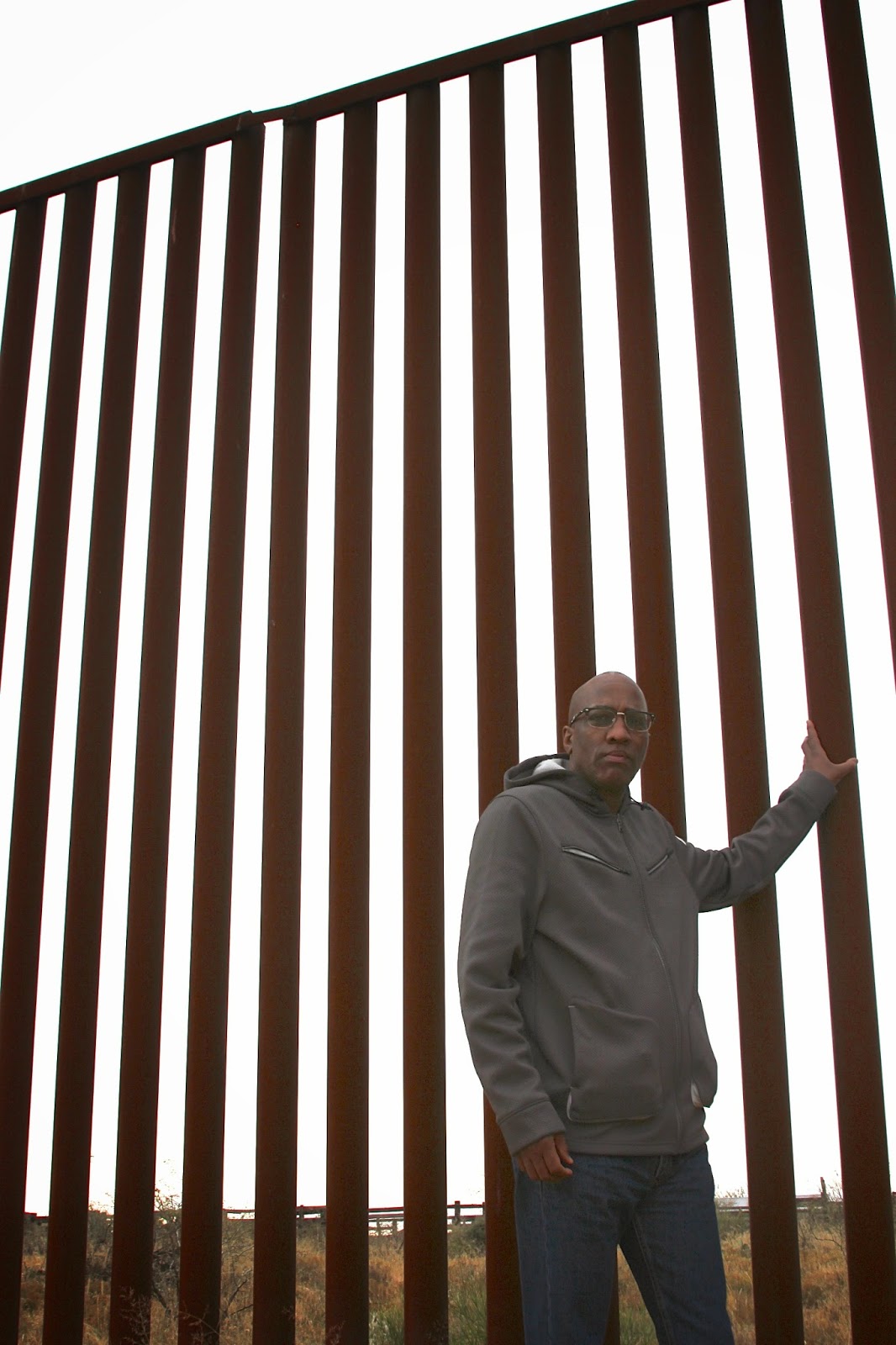
J. Herbert Nelson at the
Border Wall in Sasabe, AZ
First, relationships between persons crossing the border from Mexico and employers in the United States existed for years without major problems until the government intervened. This theme was echoed: the people of Arizona and Mexico lived with a modicum of cooperation until the construction of the border fence intervened. According to these Presbyterians in Arizona, fences were not built to prevent persons crossing the border as in other border states. Instead, the rough terrain was trusted to serve as a deterrent to border crossing. However, the escalating numbers of people crossing the border and the rising number of human remains found in the desert along the border are indications that freedom and economic livelihoods are worth sacrifice. Indeed, they are more important to many than we realize, or perhaps we just do not understand how truly desperate people are.

I heard testimonies about persons crossing the Mexican border, people who had worked on farms in their community. One gentleman spoke of his Daddy’s farm as an example. He said, “these workers crossing the border when there were no fences could return to Mexico to their families and come back freely to work. When the government became involved, Mexicans began staying, because they knew if they returned home, it was possible that they may not be able to return to the U.S. to work again the next day. This is when the problem began.” So, building walls to divide people has not solved the problem, but rather contributed, or even created it.

When an alien resides with you in your land, you shall not oppress the alien. The alien who resides with you shall be to you as the citizen among you; you shall love the alien as yourself, for you were aliens in the land of Egypt: I am the Lord your God.
- Leviticus 19:33-34

You shall not wrong or oppress a resident alien, for you were aliens in the land of Egypt. You shall not abuse any widow or orphan.
- Exodus 22:21-22

These texts instruct the people of God on how to treat the “alien,” sometimes alternately translated “foreigner” or “immigrant.” Indeed in today’s vocabulary, these passages are clearly instructions on how we must treat immigrants and refugees in our midst. The challenge is not simply to investigate the linguistic derivation of this term, but to recognize that each of these groups – aliens, widows, orphans – represents otherness in the society. In current efforts to pass comprehensive immigration reform, the issue of citizenship is not the only issue at stake. The clear implications of the texts are that no one (outcasts or otherwise) should be abused or be treated as second-class citizens. Nor should they be bereft of the assistance of the whole community in breaking the chains of oppression that bind them.

Therefore, if we take this biblical commitment seriously, the Presbyterian Church (U.S.A.) must not only advocate for a path to citizenship, but justice that ensures fair and decent wages; fair representation in judicial proceedings; educational opportunities (including fair access to state and federal funds for educating children of undocumented immigrants and non-native English-speakers); and the freedom to live without harassment and racial profiling by law enforcement.

Justice requires us to look at our own estrangement from God. By recognizing and confessing our need for internal healing in our own souls and embracing that which only the Divine can give, we are able to connect spiritually with the estrangement felt by poor, oppressed, outcast, and immigrant people. Leviticus frames it this way, “There shall be one law for the native and for the alien who resides among you” (Leviticus 24:22). In other words, a two-tier system is unacceptable.

U.S./Mexico Border Wall
Second, unjust U.S. government policies such as the North American Free Trade Agreement (NAFTA) and the Central American Free Trade Agreement (CAFTA), give U.S. corporations extraordinary power and access to the Global South.[3] The results are worker exploitation, low wages, unfair competition from subsidized U.S. goods, and increasing violence aided by the rise of drug cartels. These dynamics have created a plague of economic and physical insecurity, compelling Latin Americans to seek economic freedom and prosperity in the U.S. These same themes were echoed by Presbyterian pastors, lay people, border ministry workers, and immigrants who we spoke with when I returned to the West during my recent travel to the Arizona border in December 2014.[4]

The bible is full of faith expressions that reach beyond the spatial, societal, and geographical boundaries that humans create within our global construct. The theological core of our bible is based on crossing boundaries among cultures of people that include, but are not limited to intermarriage, faith perspectives, tribal affiliations, territorial lines and a host of other divisive, human-constructed realities. However, Jesus’ commitment to a communal ethic for the whole of humanity begins at the destruction of superficial boundaries among humankind. Jesus begins his ministry by announcing “The Spirit of the Lord is upon me and has anointed to preach the good news to the poor” (Luke 4:18). Immediately, Jesus opens a door to the embrace of outcasts who are often made poor by the structural flaws of a society that denies opportunity to the most vulnerable.

The immigration debate in the United States is about more than boundary crossing and who belongs on which side of the border. The deeper questions are “What makes the boundaries necessary?” “What makes the resistance to boundary-crossing necessary?” And “what of our own imperialism drives people in the Global South from their homes in search of something better?” This is of historical relevance for us in the United States.

We are ALL Immigrants

We must first accept that everyone in the U.S., except for First People, Native Americans and American Indians, are immigrants. The history of indentured servitude, slavery, class stratification, gender and sexuality discrimination, among others, has created a culture that permits and accepts social constructs that keep people separated from embrace and inclusion. Therefore, despite the fact of whether we are in the United States by force of bondage or desire to find a new world, the absence of freedom in the U.S. for those who are not White males is etched in the DNA of our nation. This is largely accomplished by the false construction of race, but has parallels to gender and sexuality.

From the outset, Jesus framed his ministry around breaking these barriers of exclusion. He broke bread with outcasts. He spoke with women. He identified our neighbor as other humans, not only those of our social group. Therefore, to be Christian is to challenge any barrier that prohibits the acknowledgement that this is God’s world and we are caretakers of a world we do not own. The idolatry of power and control is sin. The billions of dollars we invest on fences, walls, border patrols, drones and other devices to keep people from sharing in the benefits of God’s abundance that leads to greater possibilities for freedom – all of this is idolatry. Especially, when the poor remain poor.

In the case of immigration, we distance ourselves from our neighbors in the Global South. On the one hand, we exploit our neighbors with unfair trade agreements that serve our interests, create sociopolitical unrest, and drive people from home in search of a livelihood. And then we fail to provide refuge when persons are facing economic desperation and death as a result of our unjust policies. The flawed nature of these constructed stratified boundaries creates the tendency to be both exclusive and selective in our process of determining who has the right to be a citizen and on what basis. Our scriptures remind us that this type of behavior is antithetical to the God of life and love. Remember, “there shall be one law for the native and for the alien who resides among you” (Leviticus 24:22).

The Office of Public Witness continues to press for trade agreements that are just, fair, and provide for the welfare of our global partners. People in the Global South are seeking economic freedom in the U.S., because our free trade agreements do not represent fair trade with their countries. Therefore, border crossing into the United Sates is more often than not a desperate act, the result of our sisters and brothers seeking to achieve economic freedom for their families. This includes, but is not limited to livable wages; better working conditions; protection against underground economies (drugs, sex trafficking, etc.); and an opportunity to receive an education, build skills, and live with dignity.

Our Denominational Commitment to Comprehensive Immigration Reform

The 206th General Assembly (1994) adopted the “Call to Presbyterians to Recommit to Work and Pray for a Just and Compassionate U.S. Immigration Policy.” Again, in 1999 and 2004 Presbyterians, through General Assembly actions, guided by theological and ethical principles, continued to call for a commitment from both Presbyterians and the government to work toward welcoming immigrants into communities and passing just immigration laws. In 2010, Presbyterians addressed the most appropriate way to respond to state laws that result in members of the population being targeted for increased scrutiny.[5]

The 219th General Assembly (2010) directly responded to Arizona law SB 1070.  The Immigration Office of the PC(USA) was empowered to provide a legal resource to PC(USA) congregations in states experiencing the introduction of SB 1070 “copycat legislation.”[6] Each General Assembly, in its deliberation over the issues of immigration, has wrestled not only with policy addressing migrating people after they have already arrived here, but also with U.S. policies at the root of migration – policies that create situations that drive people from their homes and then inhibit community-building among persons who have already entered the U.S.

The Office of Public Witness has joined the PC(USA) Office of Immigration Issues, Presbyterians for Just Immigration Reform, Presbyterians in local communities, legislators, ecumenical and interfaith groups, and movement organizers, to press for changes in present laws. Our work is guided by the policies approved by the General Assembly of the PC(USA).

Faith Rally for DACA
In 2012, we celebrated a significant victory when the Obama Administration announced the creation of the program Deferred Action for Childhood Arrivals (DACA), an initiative designed to temporarily suspend the deportation of young people residing unlawfully in the U.S. who were brought to the United States as children, meet certain education requirements and generally match the criteria established under legislative proposals like the DREAM Act. While not granting a path to legal status and citizenship, DACA has now changed the lives of 650,000 young people who can remain in the country without fear of deportation, apply for work permits, and in some states get drivers’ licenses. It increases their opportunities for economic and social incorporation.

We are blessed to encounter many students who are benefiting from our work on DACA, however the struggle for full inclusion as U.S. citizens for immigrants from across the globe is barely begun. President Obama signed an Executive Order on November 20, 2014, that will allow an estimated five million undocumented immigrants to avoid deportation through an expansion of DACA and the implementation of DAPA, a similar program for parents of U.S. citizens and permanent residents. However, in February, the day before the programs were scheduled to go into effect, a Texas Judge blocked their implementation in what appeared to be a politically motivated ruling. The programs are now on hold until the lawsuits are sorted out. But Presbyterians remain committed to building a new Spirit in this world through advocacy on immigration issues and will continue to urge the immediate implementation of DACA and DAPA.

Providing Sanctuary


The Delegation meets with Rosa at Southside Presbyterian
Church in Tuscon, AZ
While in Arizona in December 2014, we met with two of the three Presbyterian Pastors whose congregations have provided sanctuary for immigrants facing deportation, as part of the Sanctuary 2014 movement. Despite community ridicule, congregational tensions, and long hours of work and interpretation, these congregations have committed to the calling of the Spirit. These three congregations and Pastors are the Reverend Eric Ledermann of University Presbyterian Church in Tempe, AZ, the Reverend Alison Harrington of Southside Presbyterian Church in Tucson, AZ; and the Reverend Adán Mairena of West Kensington Ministry (PC(USA)) in Philadelphia, PA.

Norlan tells story of his detention and
potential deportation
Two weeks after we met with Luis Lopez-Acabal, who had sought Sanctuary at University Presbyterian, Luis found out he would qualify for DAPA as step-father to his wife’s two children, and thus was able to leave Sanctuary. In mid-January, Ángela Navarro, who took Sanctuary in November at West Kensington Ministry, won her case through the organizing of that congregation and the local New Sanctuary Movement of Philadelphia.

Rosa Robles Loreto, mother of two, however, remains in Sanctuary after eight months at Southside Presbyterian Church. The local immigration office refuses to close her case, despite the strong organizing of Southside and other members of her community. She is not a high priority for deportation as a valued and loved member of the community; she shouldn’t be separated from her family.
 
The Rev. John Fife leads prayer
at the Border
I give thanks for all of the pastors and lay leaders in our denomination who have tirelessly worked for the full inclusion of immigrants in our society, those who provide shelter and hospitality, and those who are advocates for justice. While in Tucson, we spent a morning with the Reverend John Fife, Moderator of the 204th General Assembly (1992) and former pastor of Southside Presbyterian Church (U.S.A.) in Tucson, AZ. We journeyed to the border wall that separates Sasabe, AZ, from Sasabe, México; he reflected on the many migrants who have suffered in that desert and the efforts by people of faith to provide humanitarian aide. John embodies the historic commitment to comprehensive immigration reform for so many people of faith. His 20th century leadership and sacrifices lift him up as a paragon of servanthood for the sake of the Kingdom. I give thanks for his leadership and his ministry.

More Work to Do

All of these factors – fear of the other, discrimination, unjust trade policy, walls that are built to keep people out – are clear signals that the ministry of seeking justice for immigrants in the 21st century is far from complete. Prevailing powers and principalities are still hesitant to emancipate another group of persons into full citizenship, for extending citizenship will mean sharing power. Our challenge is to reinforce the intentions of Jesus Christ while living into the Beloved Community.


The Reverend Dr. J. Herbert Nelson, II, is the Director for Public Witness at the Presbyterian Church (U.S.A.) Office of Public Witness in Washington, DC.


To download a PDF of this publication, click here.

###

ENDNOTES                                                                                                                                                                               

[1] The Support Our Law Enforcement and Safe Neighborhoods Act (SB 1070) was, at the time of its passage, the broadest and strictest anti-immigrant bill in the country. The bill required local law enforcement officials to determine the immigration status of any person detained or under arrest when there is “reasonable suspicion” they are not in the U.S. with proper documentation. This bill drove a wedge into the already existing rift between local law enforcement who are charged with keeping the peace and the public good, and vulnerable communities would not report real crime (even as victims) for fear of deportation and separation from their families.

[2] During the 2010 midterm election, the Republican Party did succeed in becoming the majority in the United States House of Representatives, which was previously held by the Democratic Party. Until the midterm election Democrats were the majority in both Chambers of Congress.

[3] NAFTA’s 20-Year Legacy and the Fate of the Trans-Pacific Partnership, published by Public Citizen, Published in February 2014. http://www.citizen.org/documents/NAFTA-at-20.pdf

[4] The Reverend Gradye Parsons, Stated Clerk of the General Assembly, Presbyterian Church (U.S.A.), PC(USA) Office of Public Witness Director J. Herbert Nelson, PC(USA) Office of Immigration Issues’ Teresa Waggener, and others formed a delegation in December 2014, that journeyed to the Southwestern border to stand in solidarity with two Presbyterian churches providing protection to undocumented immigrants, as well as learn about the context of life in the borderlands: the suffering and deaths of migrants in the desert, the struggles of undocumented students to attend college, the system of immigrant detention driven by quotas and resulting in corporate profit, and responses to the summer 2014 crisis of thousands of Central Americans fleeing to the U.S./Mexico Border.

[5] “The 217th General Assembly (2006) Policy on Immigration,” published by the PC(USA) Office of Immigration Issues, http://www.pcusa.org/resource/217th-general-assembly-2006-policy-immigration/.

[6] “Commissioners’ Resolution: Regarding a Call to Stand with Immigrant Presbyterians in Their Hour of Need,” approved by the 219th General Assembly (2010), http://pc-biz.org/Explorer.aspx?id=3587.