
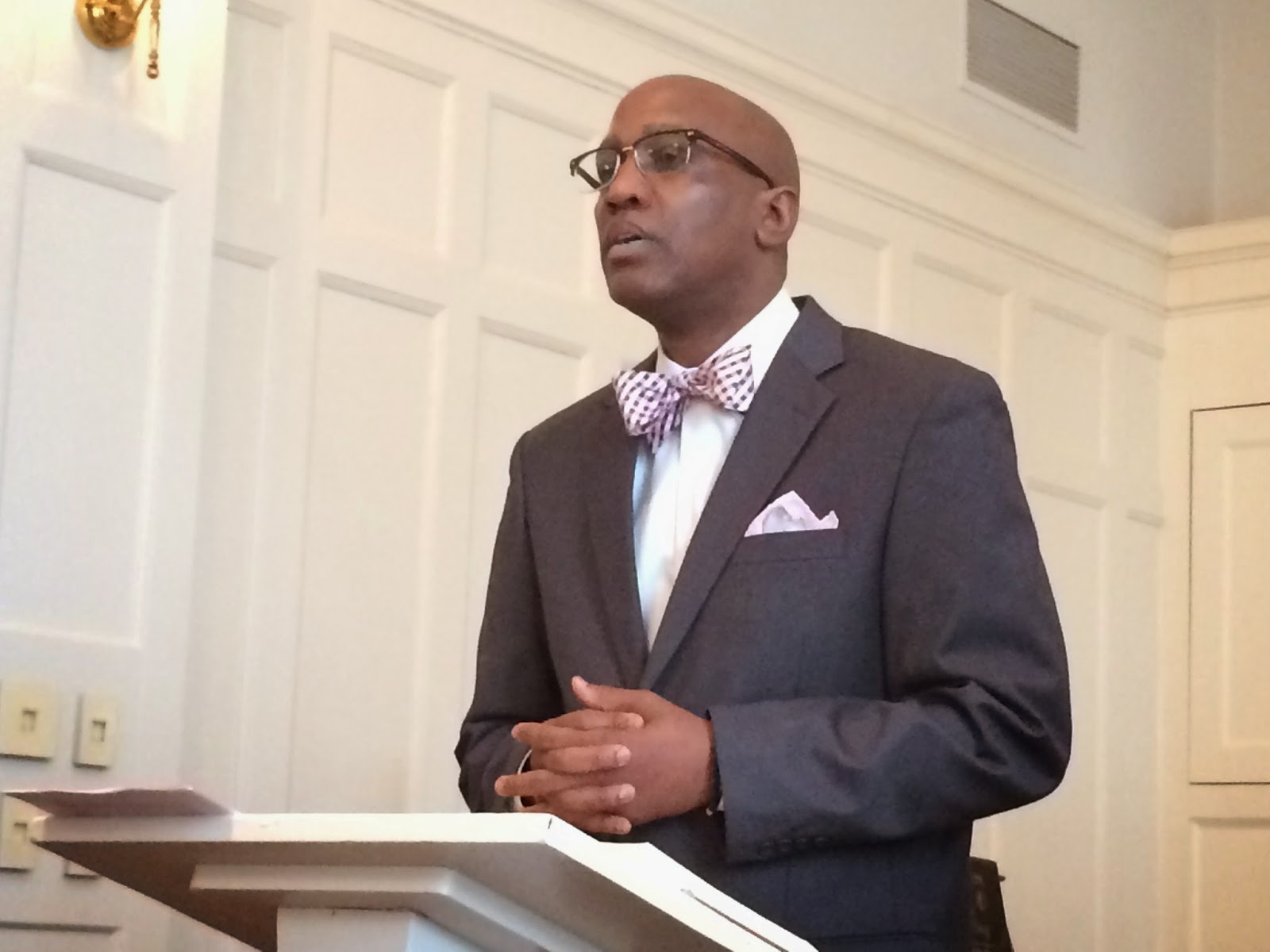
Sermon, as prepared, for the weekly Chapel Service in the United
Methodist Building, Simpson Memorial Chapel, Washington, DC, faith-based
advocacy community, on Wednesday, March 11, 2015.

If You
Believe!
Delivered by
the Rev. Dr. J. Herbert Nelson
Presbyterian
Church (U.S.A.) Director for Public Witness
When Mary came where Jesus was and saw him, she knelt at his feet and
said to him, ‘Lord, if you had been here, my brother would not have died.’ When
Jesus saw her weeping, and the Jews who came with her also weeping, he was
greatly disturbed in spirit and deeply moved. He said, ‘Where have you laid
him?’ They said to him, ‘Lord, come and see.’ Jesus began to weep. So the Jews
said, ‘See how he loved him!’ But some of them said, ‘Could not he who opened the
eyes of the blind man have kept this man from dying?’
Then Jesus, again greatly disturbed, came to the tomb. It was a cave,
and a stone was lying against it. Jesus said, ‘Take away the stone.’ Martha,
the sister of the dead man, said to him, ‘Lord, already there is a stench
because he has been dead for four days.’ Jesus
said to her, ‘Did I not tell you that if you believed, you would see the glory
of God?’ So they took away the stone. And Jesus looked upwards and said,
‘Father, I thank you for having heard me. I knew that you always hear me, but I
have said this for the sake of the crowd standing here, so that they may
believe that you sent me.’ When he had said this, he cried with a loud voice,
‘Lazarus, come out!’ The dead man came out, his hands and feet bound with
strips of cloth, and his face wrapped in a cloth. Jesus said to them, ‘Unbind
him, and let him go.’
-- John 11:32-44 (NRSV)
Our text for the day is
taken from the Gospel of John and focuses on the Resurrection of Lazarus. Jesus
came to the home of Mary and Martha, two grieving sisters whose brother died.
It is clear that they are disappointed that Jesus did not come earlier when the
word of Lazarus’ illness was received. It is obvious that the sisters believed
that Jesus’ healing power could have prevented heir brother’s death. The
scripture records Martha uttering the words more than once “Lord, if you had
been here, my brother would not have died.” (v.11:21)
Martha was concerned not
only for the healing that could have kept him alive, but also for the
observance of the rabbinical tradition calling for the embalming of the body on
the day of death, so that hovering soul of the departed could be reunited with
the body. Jesus’ four-day delay in Bethany, a nearby city, marred any chance that
Lazarus’ soul and body could be reunited, since this could have only occurred
within three days after death, according to tradition. Although we like to
think of biblical characters as having angelic thoughts in these moments, Martha’s
concern regarding her brother’s resurrection is expressed in a sharp tone when
Jesus says, “Your brother will rise.” She responds, “I know that he will arise
on the resurrection on the last day.” Jesus then responds, I am the
resurrection and the life; whoever believes in me, even if he dies, will live,
and everyone who lives and believes in me will never die. Do you believe this?”
As we engage the work of
justice in this place – Washington, DC, it is almost commonplace in these tough
political times to raise questions about God’s activity among us. There are
days when this work feels like an avalanche of concerns descending upon my
desk. Calls from constituents who act as though I am the blame for the
denomination’s problems; our office is the reason that numbers in the pews are
decreasing; and that withholding their money is the only appropriate action
that will make things better.
The fact of the matter is
that the policy we advocate for in Washington, DC, as a denomination begins in
a local Church (such as one of theirs) and we don’t work on it until it has
been approved by the General Assembly. Our office never had a vote, never took
a poll, never tweaked the language or offered the final version, however, it is
our office that bears the brunt of the criticism.
I can imagine that Jesus
understood what it was not to be responsible for the condition that angered
people, but still be blamed for it – no matter how many healing miracles, or
encounters with powers and principalities while doing advocacy work to stop
federal programs from being cut or calling for affordable health care or fighting
against a potentially disastrous Free Trade Agreement.
Think about it! He was
Bethany being bullied by the Jews who even tried to stone him for blasphemy.
Now, he arrives at the home of friends who blame him for not being there when
their brother died; for arriving too late.
“Jesus,
if you had been here my brother would not have died.”
“Jesus
you came four days after he was in the tomb and you were two miles away.”
“Jesus,
you spent your time with those people and we are your friends and you did not
come in our time of worship.”
Why don’t we personalize
this a little?
“You
mean to tell me that your office is supporting an issue I do not like. I am going to petition that we not give any
money to your office from our Church.”
Amid the multiplicity of
issues we face in this advocacy community, including the non-governance of our
elected leaders who have become puppets for domestic and global corporations;
Amid congregations and constituents who believe that their money ought to lead
our work rather than God’s will through the Holy Spirit. Amid the growing
tension in mainline protestant denominations regarding shrinking pools of money
and members; Amid discussions over LGBT inclusion and entitlement among the
wealthy; Amid the changing winds of our country’s landscape both racially and
gender identity, police murders of African American boys and men, mass
incarceration, gun violence, warring nations, and too many uneducated children,
Jesus utters these command, “Believe.”
Jesus
said to her, ”Did I not tell you that if you believe you will see the glory of
God.”
Believe that our limitations
will be met by the power of God through Jesus Christ.
In our culture, we often
live with the mentality of not having enough. Walter Bruggemann writes of us as
living in a mindset of scarcity rather than abundance. We have more than enough, but we
are locked into systems that are always reminding us of the need for more and
the fear of losing what we have. The reality is that we are a culture of poor
managers/stewards over what God has given us.

When I traveled to South
Sudan back in January, I saw children sitting out in 100+ degree heat on
handmade benches with a teacher who had a marker and a flipchart. No books,
plumbing, paper, pencils, individual seating, electricity or computers.
However, in our country, we have school buildings filled with resources and we’re
told last March that over 70 percent of our schools could possibly not achieve
No Child Left Behind standards. Where there is a Church, mosque, or synagogue
on the corner, no child or school should be left behind. It is not a matter of
resources for us, it is lack of will to educate every child in the United
States.
The growth of the prison
industrial complex in the United States is a by-product of our failure to
educate all children. So, our children and whole communities are choosing jail
over Yale – while our politicians choose profitability over integrity. It is
important that we in the faith community remember that we are people of faith
here in DC and not pseudo-political staffers in a religious office. Our work is
to assist others (both politicians and our Church constituents) to trust that
the power of God can assist us in overcoming all of our deficits. This is done
by faith-filled advocacy that leads to transformation on behalf of the Lord our
God through Jesus Christ.
Jesus did not panic in the
face of Martha’s criticisms or the skeptics that might have filled that house
of bereavement that day. No, he reminded them that resurrection was not bound
by the four-day law regarding the body and soul reuniting, but in the hands of
an awesome God who can take our moments and our days and let them flow with
ceaseless praise. We must remember this in our work.
Believe that even in our
apparent defeats, God is still in control.
I have seen many things
since coming to Washington, DC, five years ago.
Readings of Green Eggs and Ham by sitting congressional leaders. Our
President and his family maligned. Arguing over seating charts among our
congressional leaders to determine who will sit next to the other during the
State of the Union. And, while all of this is going on, we are inundated with
Isis attacks; Apartheid in the Middle East (Palestinian/Israeli struggle) – Not
to mention our own apartheid in the police killings of African American men and
ongoing border arrests, deportations that make immigrants another source of
filling jail cells and cheap labor. This environment gets overwhelming
sometimes. I have to spend time with real people so as not to become overwhelmed
with this place called Washington, DC.
I am saddened that our
efforts to enact common sense gun laws were defeated, Obamacare may be
overturned by this Court, fast-track may guide our next trade agreement, and a
faithful budget may not happen. But I remain hopeful, because I know who is in
control.


